




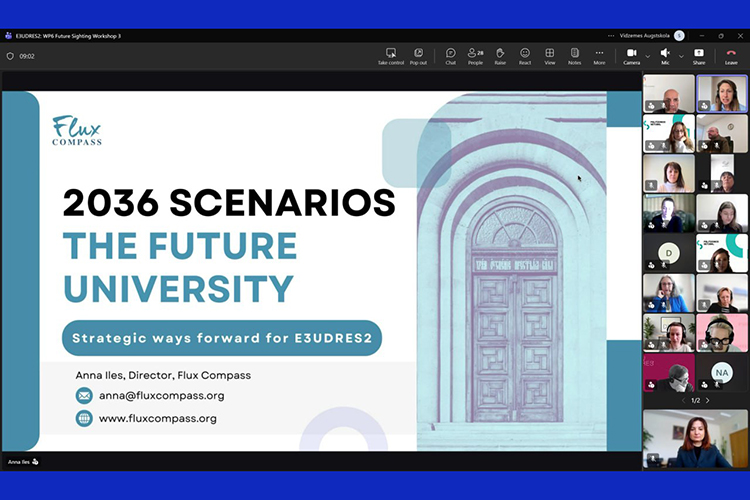
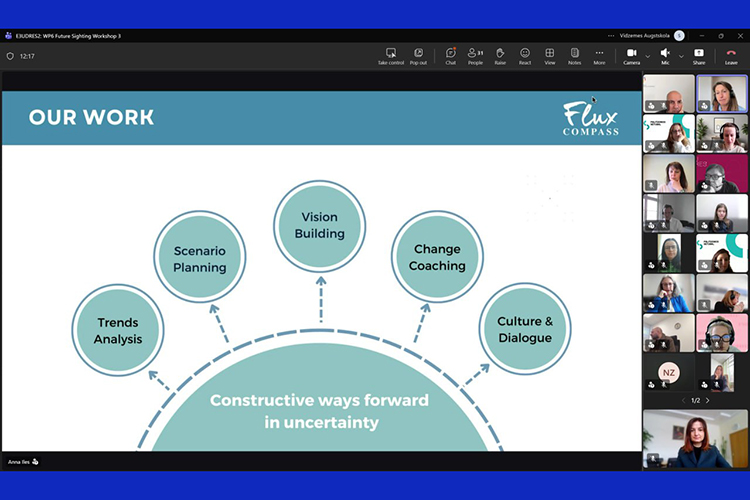
On the fourth anniversary of russia’s full-scale invasion of Ukraine, on 24 February, representatives of Bohdan Khmelnytsky National University of Cherkasy took part in the online workshop “Co-creating 2036 Scenarios for Higher Education in Europe” (“Future Sighting Workshop 3: Future Scenarios”), organised within the framework of the E³UDRES² European University Alliance.
The event brought together 32 strategists from 12 partner institutions of the alliance to jointly explore possible scenarios for the future of European higher education by 2036. The workshop was facilitated by Anna Iles, a futures coach for leaders and sustainable development strategists and Director of Flux Compass (Hong Kong).
Representing Bohdan Khmelnytsky National University of Cherkasy were Oleksandr Spriahailo, Associate Professor and Vice-Rector for Scientific, Innovation and International Activities; Nataliia Zachosova, Professor in the Department of Management and Public Administration; Halyna Lutsenko, Professor in the Department of Automation and Computer-Integrated Technologies; Svitlana Koval, Head of the International Relations Office; and Daria Tinkova, PhD, Senior Lecturer in the Department of Automation and Computer-Integrated Technologies.
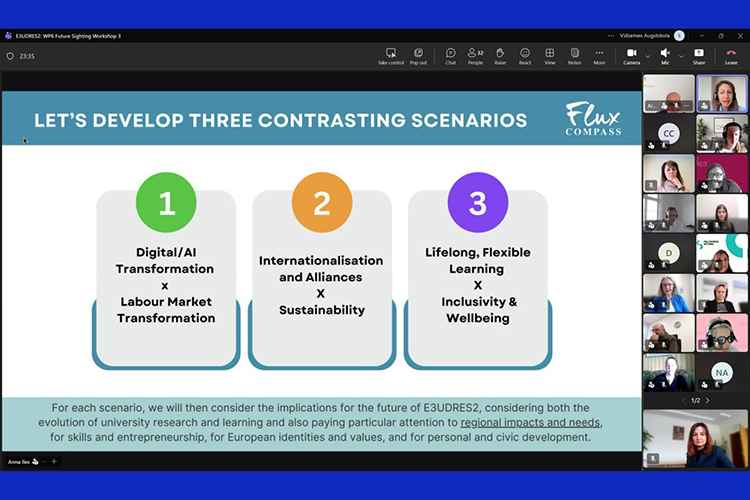
Participants worked in groups to develop scenarios across three interconnected thematic dimensions:
– Digital/AI transformation × labour market transformation.
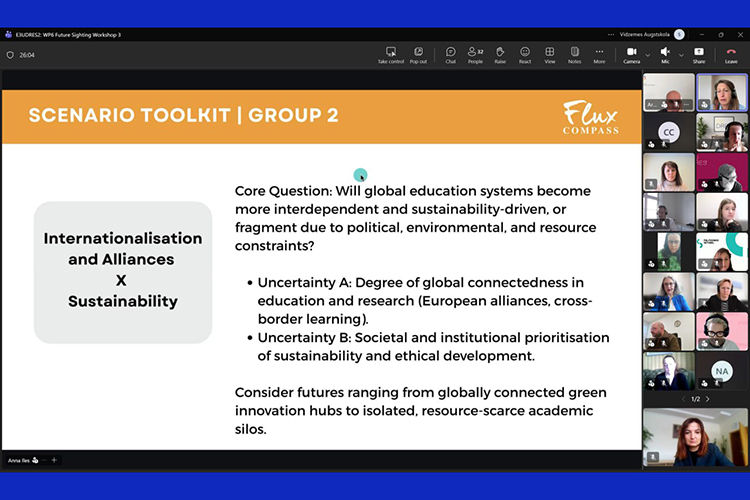
– Internationalisation and university alliances × sustainability.
– Lifelong learning and flexible educational pathways × inclusion and wellbeing.
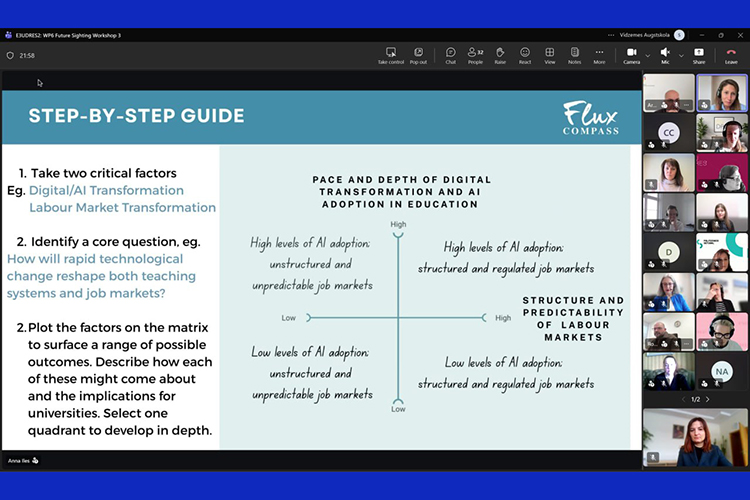
The first group focused on risks associated with the pace of technological change. If digital transformation and the development of artificial intelligence outpace the capacity of universities to adapt, the “digitalisation gap” between institutions may widen.
Participants emphasised the need to:
accelerate mutual learning among universities;
reconsider the duration and structure of educational programmes in line with emerging competencies;
co-create micro-credentials with industry;
develop shared competency frameworks as guides for educational reforms.
Within the second scenario, participants modelled an uncomfortable future: a fragmented Europe where sectors operate in isolation, short-term economic gains outweigh social and planetary wellbeing, and university degrees lose their value. In such a scenario, funding decreases, academic mobility becomes restricted, and commercially driven “fast education” undermines quality. Universities risk turning from institutions of transformation into those of survival.
The third scenario addressed lifelong learning. Participants discussed whether modular educational pathways, stackable credentials, and systemic wellbeing support can meet the needs of different categories of learners, from school graduates to older adults. It was concluded that flexibility is not only a matter of programme design but primarily a cultural transformation of the university. Academic staff need to practise lifelong learning themselves in order to credibly promote it, while students should receive support for responsible choices of educational pathways without detriment to their mental health.
The overarching conclusion of the workshop was that the decisions European universities make over the next decade – regarding alliances, digital technologies, labour market links and student support – will determine whether they remain reputable public institutions or become optional elements in a volatile skills market. Participants highlighted the value of the scenario planning methodology for building a shared language for risks, opportunities, and responsibilities. Working on the 2036 scenarios enabled participants to move beyond conventional management frameworks and consider the future of higher education in a systemic way, taking into account both regional and pan-European challenges.
“For Bohdan Khmelnytsky National University of Cherkasy, participation in such strategic discussions is an important element of internationalisation and institutional capacity development. The partnership within E³UDRES² creates a platform for experimenting with new educational models, implementing AI-based solutions, developing shared competency frameworks, and strengthening academic mobility,” noted Oleksandr Spriahailo. “In times of societal instability and global transformations, such collaborative formats allow universities not only to respond to changes but also to shape the desired future, remaining drivers of regional development and of Europe as a whole.”
International Relations Office
http://cdu.edu.ua/en/news-en/bknuc-participated-in-the-strategic-workshop-e-udres-co-creating-2036-scenarios-for-higher-education-in-europe.html#sigProIdc969618dec
International Relations Office


